Mexican Presidential Press Conferences on YouTubeAfter reading this chapter, I want to discuss the morning press conferences hosted by Claudia Sheinbaum, the current Mexican president, that are hosted live on YouTube as an example of both cold media and mass communication. According to the textbook, cold media refers to the multi-sensory elements of the audiovisual livestream and mass communication refers to the press conferences’ intent to be received by a a large, public audience. Personally, I first learned about these press conferences after my dad shared that he enjoys watching them as part of his morning routine. Since then, a notable segment that my family members and I discussed featured a popular musician, Junior H, who was there to promote a government sponsored music contest and talk about his artistry. This segment is an effective example of how these morning presidential press conferences are both cold media and mass communication, since the livestreams are hosted on YouTube, an online platform intended to distribute videos to as many people as possible. I chose this specific example to illustrate these concepts because this particular press conference received more visibility among Mexican nationals around the world. Unlike other streams, this specific stream was circulated widely and repeatedly amongst my family because the older generation in my family recognized that us, the younger generation, would appreciate and understand Junior H’s statements […]“Mexican Presidential Press Conferences on YouTube”
Donors and Users: Class PracticumDue Date: July 17, 11:59pm First, sign up for a Commons account. Then, add your contribution in the comments of this […]
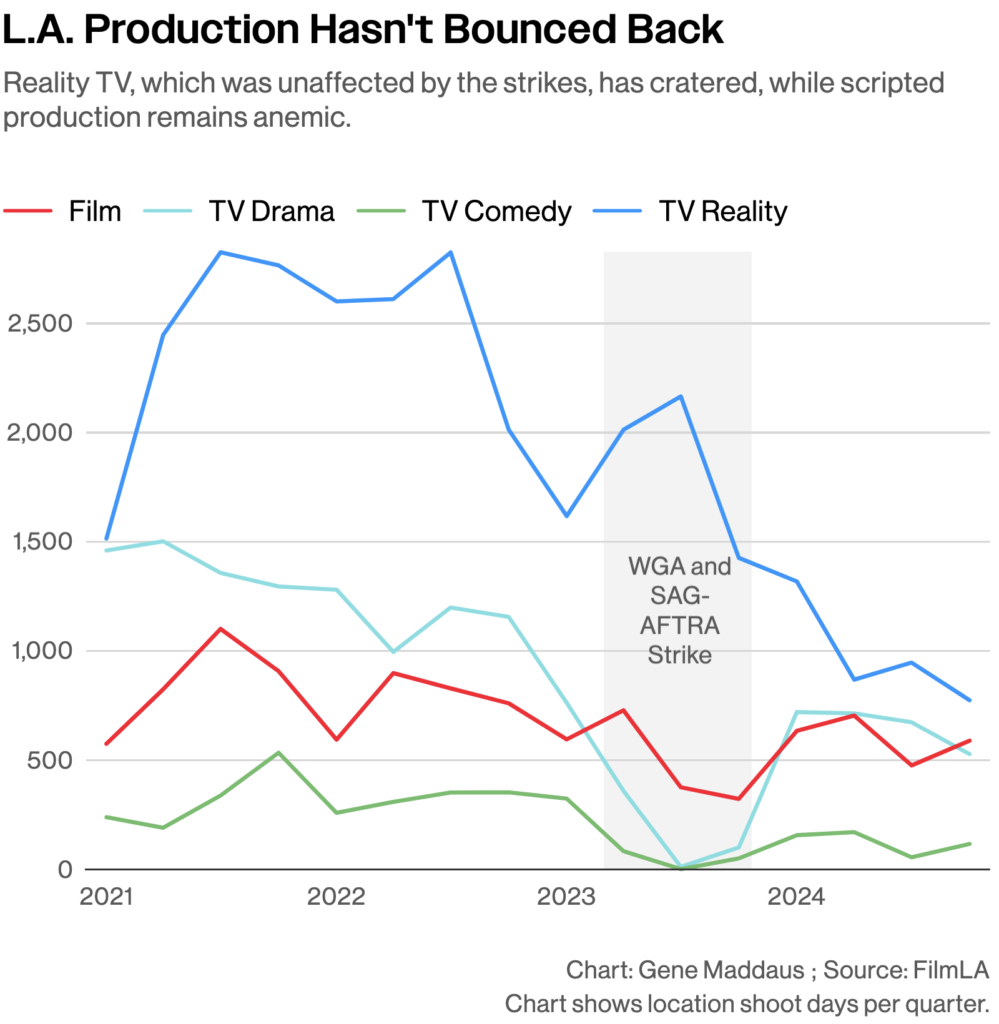
Reporting Industry Trends Using Quantitative Research The graph below, originating from the Variety article titled, “After L.A. Fires, Bringing Production Back Has Become More Urgent Than Ever” is an example of quantitative research used to support the writer’s reporting about the state of film and television production after the California wildfires. This graph is an example of quantitative research because it utilizes empirical data to quantify the amount of production by tracking the number of shooting days per quarter. While the graph quantifies the fluctuating amount of production from 2021 to 2024, the article’s authors utilize this quantitative research to support their reporting on the state of film and television production in Los Angeles after the California wildfires. For this article, quantitative research effectively supports the authors’ reporting about production in California in addition to interviews with industry insiders. Personally, I am the type of film student who enjoys reading trade magazines like Variety and The Hollywood Reporter because I am able to learn about multiple current issues that the industry navigates in a more accessible form versus reading academic literature. Furthermore, I enjoy reading film industry trade magazines because I learn more about currently circulating movies and television shows, often directly from […]“Reporting Industry Trends Using Quantitative Research”
Email us at [email protected] so we can respond to your questions and requests. Please email from your CUNY email address if possible. Or visit our help site for more information:











Recent Comments